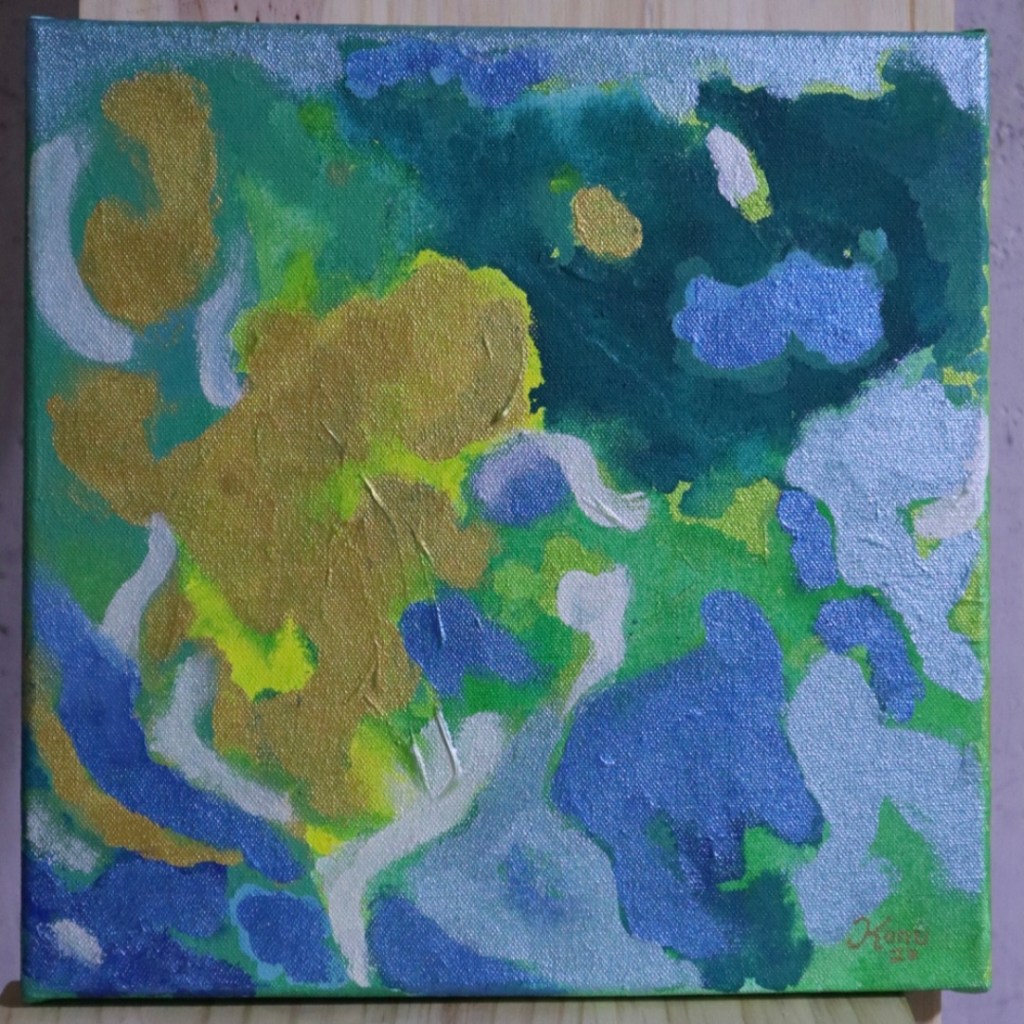
In this piece I really continued the technique wherein large fields of colour border each other with contrasting variation. Gold touches blue, touching green, and so on. It creates a very interesting pattern, in my eccentric opinion.

In this piece I really continued the technique wherein large fields of colour border each other with contrasting variation. Gold touches blue, touching green, and so on. It creates a very interesting pattern, in my eccentric opinion.

Green arm reaching out into blue field
In this piece I explore colours further by creating fields of colour that melt into one another. This vibrant green compliments blue in this example.
Exploring colour blending. As my body of work builds, I am always trying new techniques.

This piece reminds me of sunlight meeting ocean. What do you see?
A fast paced art video displaying some of my work thus far. Thanks for watching 👀




Theorists such as Gardner and Sternberg have each presented different definitions and categories of intelligence.[34] Richard Gunderman refers to emotional intelligence as a type of intelligence, in addition to the commonly used definition. He has defined it as “the ability to understand and respond to emotions in daily life”.[32] For instance, a person who does not face his or her emotions and tackle them may be constantly frustrated. This person will face troubles moving on with his or her life. Consequently, emotionally intelligent individuals are better at expressing and identifying their emotions and those of the people around them. Those who are adept at handling their emotions tend to live an easier life than those who are not. Since people with better emotional intelligence are sensitive to emotions, they are considered better team players and are family-oriented.
Some researchers argue that emotional intelligence is biological, while others say it is innate. Gunderman states that emotional intelligence is a learned and an instinctual skill.[32] According to him, it can be cultivated through three means: learning more about it, drawing attention to it for oneself and others, and reading the works of authors he considers to be emotionally intelligent, such as Jane Austen and Leo Tolstoy.[32] Through engaging in emotional expressions and regulation, it is contemplated more than before and brings forth considerable changes in life and attitude. Sy and Cote conducted a study that proved emotionally intelligent are more competent and perform better. Therefore, many companies are using “EI training programs” to increase matrix performance.[35]
Social construction models generally say that there is no biological circuitry for emotions since emotions are solely based on experience and context. Some even suggest that certain emotions can only exist in the reciprocal exchanges of a social encounter. Since there are unique local languages and local moral orders, cultures can use the same emotion and expression in very different ways.[30] Thus, emotional expressions are culturally-prescribed performances rather than internal mental events. Knowing a social script for a certain emotion allows one to enact the emotional behaviours that are appropriate for the cultural context.[24] Emotional expressions serve a social function and are essentially a way of reaching out to the world.[31]
Another model of emotion, called psychological construction, describes emotion as a construction that results from more basic psychological processes. In a psychological construction model, basic psychological processes like affect (positive or negative feeling combined with some degree of physiological activation), previous experiences, language, and executive functioning combine to form a discrete emotion experience [26]. While some discrete emotions tend to have typical responses (e.g. crying when sad, laughing when happy), a psychological construction model can account for the wide variability in emotional expression (e.g. crying when extremely happy; laughing when uncomfortable). Psychological construction models call into question the assumption that there are basic, discrete emotion expressions that are universally recognized. Many basic emotion studies use highly posed, stereotypical facial expressions as emotional signals such as a pout, which would indicate one is feeling sad. These facial expressions can be better understood as symbols of emotion rather than signals.[27] While these symbols have undeniable emotional meaning and are consistently observed during day-day emotional behavior, they do not have a 1-to-1 relationship a person’s internal mental or emotional state. For example, not everyone furrows their brow when they are feeling angry. Moreover, these emotional symbols are not universal due to cultural differences. For example, when Western individuals are asked to identify an emotional expression on a specific face, in an experimental task, they focus on the target’s facial expression. Japanese individuals use the information of the surrounding faces to determine the emotional state of the target face.[28] This challenges experiments that solely use a presentation of an isolated emotional expression in experiments because it is reflecting just a Western notion of emotion.[16][17][18][29]
Appraisal models of emotion state that emotions are triggered by mental states that are truly unique in both form and function. Appraisal models are similar to the basic model of emotion in that both views consider that, once an emotion is triggered, emotional expressions are biologically predetermined and are displayed only in one emotion and every time that emotion is expressed. The main difference between basic emotion models and appraisal models is that appraisal models assume that there is a cognitive antecedent that determines which emotion is triggered. Traditional appraisal theories consider appraisals to be universal and like a set of switches that can be turned on by biological and environmental triggers. When a person makes an appraisal, an individual will react with an appropriate, emotional response that can include an external, emotional expression. More recent appraisal models account for variation in emotional expression by suggesting that cognitive appraisals are more like themes that can be triggered by a number of different actions and situations. Emotional expressions arise from these appraisals, which essentially describe the context of the situation.[24] One appraisal model has developed the law of situational meaning, which states that emotions tend to be evoked by certain kinds of events. For example, grief is elicited by personal loss. In this case, personal loss would be the appraisal and one can express grief through emotional expressions.[25]
There are many different theories about the nature of emotion and the way that it is represented in the brain and body. Of the elements that distinguish between the theories of emotion, perhaps the most salient is differing perspectives on emotional expression.[7][8]
Some theories about emotion consider emotions to be biologically basic and stable across people and cultures.[2][9][10] These are often called “basic emotion” perspectives because they view emotion as biologically basic. From this perspective, an individual’s emotional expressions are sufficient to determine a person’s internal, emotional state. If a person is smiling, they are happy. If a person is crying, they are sad. Each emotion has a consistent and specific pattern of expressions, and that pattern of responses is only expressed during that emotion and not during other emotions. Facial emotional expressions are particularly salient stimuli for transferring important nonverbal signals to others. For that reason, emotional expressions are the best direct indicators of affective attitudes and dispositions. There is growing evidence that brain regions generally engaged in the processing of emotional information are also activated during the processing of facial emotions.[11][12]
Some theories of emotion take the stance that emotional expression is more flexible, and that there is a cognitive component to emotion. These theories account for the malleability in emotion by proposing that humans appraise situations and, depending on the result of their appraisal, different emotions and the corresponding expressions of emotion are triggered. The tendency to appraise certain situations as one emotion or another can vary by person and culture; however, appraisal models still maintain that there are basic responses that are specific and consistent to each emotion that humans feel.[13][14][15]
Other theories of emotion propose that emotions are constructed based upon the person, situation, culture, and past experiences, and that there are no preset emotional responses that are consistent and specific to one emotion or another.
 Lillybochic